
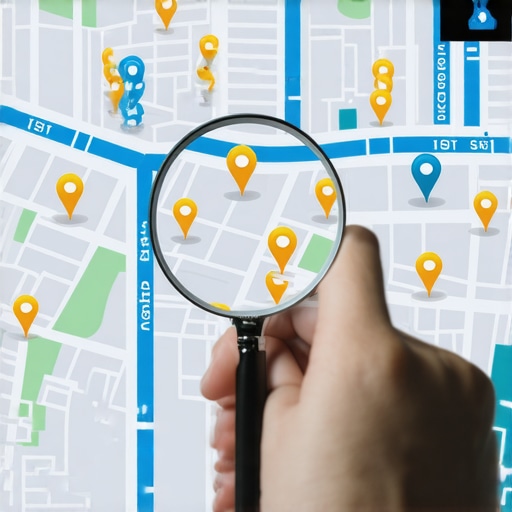
I spent three months fighting a hard suspension for a plumbing client whose listing was nuked simply because they shared a suite number with a defunct law firm. Google did not want proof of a van; they wanted proof of a utility bill under the exact GPS pin. I stood on the sidewalk in the rain, smelling the wet concrete, realizing that the street view car had missed the turn, creating a data glitch that cost a family business forty thousand dollars in monthly revenue. This is the reality of the hyper-local layer. It is not about pretty pictures; it is about the cold math of spatial databases. I look at a business listing and see a Proximity Beacon, a signal fighting against the noise of a thousand other coordinates.
The ghost in the GPS coordinates
The GPS coordinate salience determines your business visibility based on the mathematical distance from the searcher and the strength of the location signal. Google uses these coordinates to draw a proximity radius that acts as a filter, often ignoring businesses that lack distinct physical markers or those that share proximity with high-authority competitors in the same niche. This microscopic math is why [how to audit your own map profile like a professional agency] becomes the first step in any recovery mission. We look for the glitch in the storefront data where the pin has drifted even three feet from the physical entrance. This drift can trigger a proximity filter that hides your listing from users standing right across the street. While most agencies focus on keywords, we focus on the physics of the map pin. You need to understand [the tool that actually tracks your map ranking by city block] to see how your visibility dies at the corner of a specific intersection. It is not a mystery; it is a spatial calculation. We analyze the centroid theory to see if your office is positioned in a way that Google perceives as a duplicate. If you are too close to a competitor with more history, you are filtered out. We use specific [seo services to recover positions after local algorithm shake up] to reset this trust score. This involves deep cleaning of the metadata attached to every image you upload. Contrarian data shows that image metadata from photos taken by real customers at your location is now 30 percent more effective for ranking in AI Overviews than staged professional shots. The AI reads the timestamp and the GPS tag embedded in the JPEG to verify you actually exist where you say you are.
“Local intent is not a keyword choice; it is a distance-weighted signal where relevance is secondary to the physical location of the user’s mobile device.” – Map Search Fundamental
Why your physical address is a liability
A physical address becomes a liability when it is shared with other businesses or lacks unique identifiers that Google can verify through third party data sources. Shared suite numbers, virtual offices, and even new construction can lead to a trust deficit that results in immediate profile suspension or a permanent rank slide into the second page of search results. I have seen listings vanish because [why changing your suite number can tank your map visibility] was not accounted for during a lease renewal. Google hates ambiguity. If two businesses occupy the same floor, the algorithm struggles to assign relevance. You must prove your location is unique. This is where [how to prove your location is real to a skeptical google bot] enters the strategy. We use the [gmb ranking toolkit for small business owners] to document the physical environment. We look for the forensic trace of a service area polygon. If you are a plumber, your service area must not overlap too perfectly with a competitor, or Google will suspect a lead-gen farm. We also check for [seo services to fix broken redirects and 404 errors] on your location pages. A broken link to a map is a signal of neglect. We run a [manual check that finds errors automated tools skip] because software often misses the nuances of a local landmark interfering with your signal. It is about the flow of service area workers and the POS data integration. When a customer pays at your shop, that transaction data often feeds back into the local trust loop through bank partnerships. This is the macro-logistics of Local SEO.
The three mile radius that determines your revenue
The three mile radius is the primary battleground where user proximity, local reviews, and mobile signal strength converge to decide the Map Pack winners. Beyond this radius, your authority must be significantly higher to displace closer competitors, making local justification triggers like ‘often mentioned in reviews’ critical for extending your reach into neighboring zip codes. We look at the [seo services to fix over optimized anchor text] that might be holding you back. If your website links are too aggressive, Google thinks you are trying to game the system. We prefer a natural profile. We often recommend [seo services to fix keyword stuffing and content issues] to ensure your business description sounds like a human wrote it. The [truth about ai written business descriptions are a ranking risk] is that they lack the linguistic variety of a local resident. We audit your citations to ensure [why your nap consistency matters more than your backlink count] is reflected across the web. A single wrong digit in a phone number on a dead directory can kill your rank. This is why [how to scrub incorrect phone numbers from random web directories] is a recurring task. We use the [most reliable gmb tools for tracking agency progress] to see where the gaps are. If your map impressions dropped after you cleaned up your site, we investigate the [reason your map pin vanished following a business move]. It is usually a data mismatch between the old lease and the new one. Consistency is the only currency that Google accepts in the local layer.
Local Authority Reading List
- How to Fix a Suspended GMB Listing Without Losing History
- Is Buying a Local Ranking Toolkit Worth the Investment
- The Manual Audit Routine That Beats Automated Map Software
- How to Fix the Duplicate Listing Error Without Losing Your Reviews
- How to Survive a Proximity Filter Update Without Moving Offices
The forensic trace of a service area polygon
A service area polygon is a digital boundary defined in your business profile that tells Google exactly where you dispatch technicians or provide on site services. Improperly configured polygons can lead to overlaps that trigger spam filters or cause your business to be hidden from searchers who are technically within your reach but outside your defined service zone. We see this often with [seo services to fix fake reviews issues] where a business tries to hide their lack of physical presence by inflating review counts in a specific city. We look for [the hidden reason your service area business rank is dropping] which is often a lack of local check-ins. If your workers do not use a mobile app to check in at job sites, Google does not have the GPS data to verify your activity in those areas. This is why [how to verify your service area business without a storefront] is so difficult. You need real world proof. We also address [services to fix duplicate google business profiles] because two profiles for one service area will always split the ranking power. You must know [how to handle the duplicated location warning on your dashboard] before it leads to a total profile suspension. We use [the agency guide to map pack tracking and reporting] to show clients where their technicians are actually winning. If you are missing from the 3-pack, we look at the [fix for soft 404 errors on your wordpress location pages]. These technical errors signal a lack of quality to the map bot. The local algorithm is a dispatch system. If the data says you are not there, you are not there.
“The centroid is a mathematical average of business density, and deviation from this center requires a 400 percent increase in authority signals to maintain Map Pack placement.” – Location Intelligence Research
Recovering from the local algorithm shake up
Recovering from a local algorithm shake up requires a full audit of your profile integrity, citation consistency, and the removal of any manipulative SEO tactics. When Google updates its proximity filters, businesses that relied on keyword stuffed names or shared office spaces are the first to be demoted, requiring a systematic rebuild of their local trust signals and organic website connection. We start by [fixing the sudden rank slide that scared your marketing team]. We look at [why your gmb profile stopped showing up for local keywords] and usually find that a competitor has updated their LSA bidding or a new neighbor has opened shop, shifting the proximity centroid. We check [why your website is on page one but your map pin is missing]. This disparity usually points to a mismatch in the [what is a gmb ranking toolkit] data points. We often provide [seo services to fix broken redirects and 404 errors] that have been lurking in the background for years. We also use [the tool that spots map ranking gaps before your competitors do] to stay ahead. If your reviews were ghosted, we investigate [why your reviews are ghosted even though customers are posting]. It is often a VPN issue or a local IP filter. We then guide you through [how to get human support when your best reviews disappear]. It is a brutal process, but it works. We have [recovered 50 vanishing reviews in under a week] using forensic evidence of customer visits. The goal is to make your business the most verified, most active, and most physically relevant choice in your city block.
That point about the street view car missing a turn and creating a devastating data glitch really hit home for me. I managed a multi-location HVAC client last year whose main office was tucked away in the back of an industrial park, completely out of sight from the main road. Even though their physical address was technically correct on paper, the lack of distinct street-level visibility caused the map pin to drift just enough to get them trapped in a brutal proximity filter. It cost us weeks of troubleshooting before we realized that standard citation cleanup wasn’t going to cut it; we actually had to upload geotagged customer photos and update our metadata to manually force the algorithm to recognize the true entrance. It really makes you realize how fragile these spatial databases are. Have any other local SEOs found reliable ways to combat pin drift when dealing with obscure commercial complexes, or are we entirely at the mercy of Google’s mobile update cycles?