
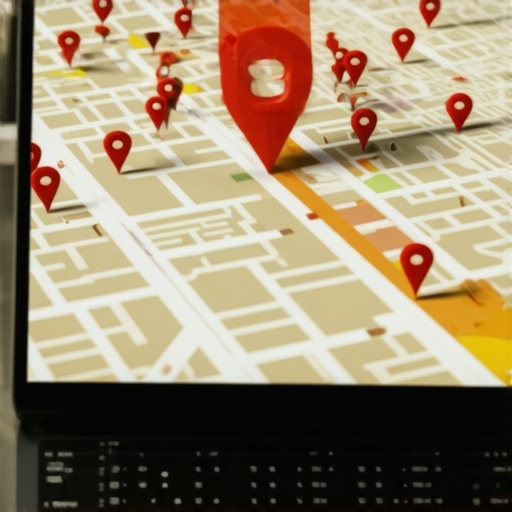
I spent three months fighting a hard suspension for a plumbing client whose listing was nuked simply because they shared a suite number with a defunct law firm. Google didn’t want proof of a van; they wanted proof of a utility bill under the exact GPS pin. This was not just a bureaucratic error. It was a failure of the local algorithm to distinguish between a legitimate service business and the digital ghosts left behind by a previous tenant. The air in that plumber’s warehouse smelled like wet concrete and heavy industrial grease, a sensory reality that Google’s bot could not parse from a satellite view. This frustration is what real business owners face while lead generation sites and map-spam syndicates thrive by planting fake pins in the center of every major city. They are stealing your clicks by gaming the math of proximity.
The ghost in the GPS coordinates
Fake business addresses and lead generation spam represent the biggest threats to Google Business Profile integrity in the current local search ecosystem. These competitors often use virtual offices, coworking spaces, or residential basements to create a proximity beacon that intercepts local search traffic from legitimate storefronts. You can spot these ghosts by looking for NAP inconsistency, lack of permanent signage, and stock photography instead of real interior shots. If you find your listing is being buried, you need to understand how to wipe fake competitor listings off your local map to restore your fair market share.
When a competitor sets up a fake address, they are exploiting the centroid theory of local search. Google prefers to show results closest to the user’s mobile device or the center of the searched city. By renting a mailbox in a high-density area, a spammer can appear to be the most relevant option. This is a mathematical trick. The algorithm calculates the distance between the GPS coordinates of the user and the verified address on the profile. If that address is a Regus office or a UPS store, they are violating the Google Business Profile Terms of Service. You must look for the glitch in the storefront data. Does the Street View show a skyscraper when the business claims to be a landscaping yard? Does the sign on the door match the name on the listing? Often, these listings are the result of gmb issues caused by virtual office or coworking space environments where dozens of businesses claim the same ten square feet of space.
“Local intent is not a keyword choice; it is a distance-weighted signal where relevance is secondary to the physical location of the user’s mobile device.” – Map Search Fundamental
Why your physical address is a liability
Physical storefronts are now under extreme scrutiny because automated spam filters struggle to differentiate between legitimate home-based businesses and fraudulent lead gen sites. If your business moves or if you have a mismatched phone number, the trust score of your map pin can drop to zero in a single update. This is especially true for service area businesses that do not have a publicly visible address. The algorithm looks for third-party citations on sites like Yelp and Bing to verify your reality. If those sites have your old data, you will see a massive drop in map pack rankings. This is exactly why your map pin still shows your old office address after moving and why you must be aggressive with citation cleanup.
The liability of a physical address often comes down to suite numbers. Spammers love to leave the suite number off their listing to confuse the bot into thinking they occupy the entire building. If you are sharing a building with twenty other companies, your local justification triggers might be suppressed because Google cannot determine which business is the most prominent at that specific latitude and longitude. I have seen cases where a change in suite number tanked map visibility for months because the local SEO signals became fractured across multiple digital records. The bot sees two entities at the same point and applies a de-duplication filter, effectively hiding one of them from the 3-pack.
The three mile radius that determines your revenue
Proximity radius logic dictates that most local conversions happen within a three to five mile circle around the business location. Competitors who use fake addresses are trying to expand this circle by placing multiple pins across a metro area. This is often done via keyword-stuffed business names that include city names to trick the relevance engine. If you notice a competitor ranking for terms they shouldn’t, check their backlink profile and review patterns. Often, these spam listings have zero organic authority but high map visibility due to their strategic (and fake) location. You may need ranking recovery strategies for gmb to combat this kind of aggressive spatial manipulation.
The math of the Vicinity Update changed how we view these circles. Google shifted the weight toward physical proximity even more than organic authority. This means a low-quality business can outrank a high-quality veteran business simply because they are closer to the user. When a competitor uses a fake address in the center of the city, they are basically jumping the line. You have to prove to Google that their location is a ghost. This involves checking the Secretary of State records or looking for business licenses that match the 100 percent exact name and address on their profile. If they cannot produce a utility bill for that spot, they shouldn’t be there. Many owners find that competitors reporting your address as fake is a common tactic in high-stakes niches like locksmithing or plumbing.
Local Authority Reading List
- The manual check that finds errors automated tools skip
- How to prove your location is real to a skeptical google bot
- Why your nap consistency matters more than your backlink count
- How to fix the duplicate listing error without losing your reviews
- The tool that actually tracks your map ranking by city block
The forensic trace of a fraudulent listing
Identifying map spam requires a keen eye for digital inconsistencies and photographic glitches. One of the easiest ways to spot a fake GMB listing is to look at the photos. Are they staged stock photos? Does the interior of the office look like a generic lounge with no company branding? Real businesses have clutter. They have employee photos. They have trucks with logos parked out front. If the Google Business Profile only shows the outside of a building and some generic computer screens, you are likely looking at a lead generation site. This is a clear signal to use how to report spam profiles and get them removed fast protocols.
Another forensic marker is the review velocity. If a business that claims to be in a quiet suburban office building suddenly gets twenty 5-star reviews in a week, something is wrong. Usually, these reviews come from profiles with no history or users who have reviewed businesses in five different states in the same day. This is a review farm at work. These fake listings use these sentiment signals to bolster their proximity rank. While you are working hard on expert tips for gmb optimization, these spammers are using black hat software to inflate their numbers. You must document these patterns when you submit a redressal form to the Google Maps spam team.
“Local justification is the bridge between a user’s specific query and the static data of a business profile, often triggered by review text and website mentions.” – Vicinity Research Group
Recovering your rank after a spam attack
Ranking recovery is a process of reclaiming the trust signals that a spammer has stolen from you. When fake competitors flood the map, your impression share drops and your click-through rate suffers. This often looks like a sudden ranking crash on your geo-grid reports. You might find that your map pin is filtered out because Google thinks you are a duplicate of one of these fake listings. To fix this, you need a search recovery plan for penalized local profiles that focuses on hard data. You must prove your physical existence through video verification and geo-tagged photos.
Don’t rely on automated SEO tools to find these issues for you. Most local seo software will tell you your rankings are fine while your phone is dead. This is the disparity between seo software and actual map rankings. You need to perform a manual audit of the map for your top-tier keywords. If you see a business name like “Plumber City Name Cheap,” that is a keyword-stuffed listing that should be reported immediately. Clearing out this digital clutter is the fastest way to see your own map pack visibility return to normal. The war for the 3-pack is fought in the details of NAP consistency and verified location data. Every fake pin you remove is a direct win for your bottom line revenue.
Ultimately, the goal is to create a Proximity Beacon that is so well-verified that Google cannot ignore it. This means having consistent business hours, real-time posts, and customer photos that prove people actually visit your physical location. If you are a service area business, it means being honest about your service boundaries and not trying to claim a city where you don’t have a legal presence. The transparency you provide is your best defense against the hidden penalty for using virtual offices. Keep your data clean, keep your photos real, and keep your competitors honest through constant monitoring of the map.
This article hits on a massive frustration that I think every legitimate local business owner has dealt with at some point. I went through a nearly identical nightmare last year when a lead-gen outfit popped up right down the street using a virtual mailbox inside a UPS store. They didn’t even have a physical van, yet they were dominating the map pack for half our core keywords simply because they gamed the proximity centroid. What drove me nuts was how difficult it was to get Google to actually look at the manual evidence. Automated reporting tools basically did nothing, and it wasn’t until we pulled Secretary of State filings and submitted a formal redressal form with time-stamped photos that the listing finally dropped off. It honestly feels like honest businesses are constantly playing defense against digital ghosts while the algorithms struggle to catch up. For those of you who have successfully cleaned up your local map pack from these fake pins, what has been your most reliable method for getting the spam team to take action quickly?