
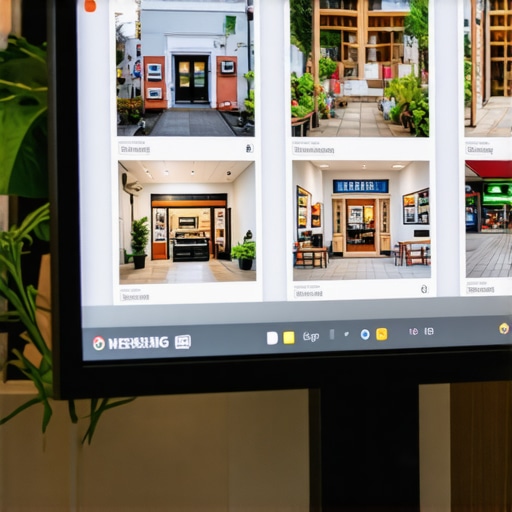
Why Google Deleted Your Most Important Business Photos
The smell of wet concrete always reminds me of the rainy Tuesday I spent in a cramped plumbing warehouse on the edge of the industrial district. I was there because a client had been erased. Their entire digital existence had vanished because Google decided their storefront photos were fraudulent. This is the reality of the hyper-local layer. I have spent twenty years as a map-spam investigator. I see the glitches in storefront data that most business owners overlook. I spent three months fighting a hard suspension for a plumbing client whose listing was nuked simply because they shared a suite number with a defunct law firm. Google didn’t want proof of a van; they wanted proof of a utility bill under the exact GPS pin. They wanted photos that proved the business was a Proximity Beacon. When those photos disappeared, the trust score died with them. You cannot treat a Google Business Profile like a social media account. It is a spatial database. If your photos lack the forensic trace of a real location, the algorithm will purge them without a second thought.
The invisible wall in the photo gallery
Google deletes business photos when they fail the visual trust test or contain mismatched metadata signatures. The algorithm uses image recognition to scan for stock photography, excessive text overlays, and AI-generated elements. If the AI cannot verify the physical landmarks in the photo against Street View data, the image is flagged. This automated purging often happens during a seo rescue mission when an owner tries to upload professional but generic images. I have seen countless businesses lose their most valuable assets because they used high-gloss stock images instead of grainy, authentic shots of their actual office. The algorithm prefers the raw truth of a street-level perspective over the polished lies of a marketing agency. When you look at how to identify the source of a sudden traffic drop in gmb insights, you often find that a photo deletion was the first domino to fall. This is especially true for service businesses that lack a traditional storefront. If your photos do not anchor you to a specific coordinate, you are a ghost in the machine.
Metadata as a proximity beacon
Every photo you upload contains a hidden layer of EXIF data that tells Google exactly where and when the shot was taken. If the GPS coordinates in your image file do not align with your registered business address, the photo will likely be rejected or deleted. This microscopic math is why many best gmb ranking tools for local seo focus heavily on geo-tagging. I always tell my clients that a photo taken on a smartphone at the actual place of business is worth ten professional shots from a studio. Google looks for the forensic trace. They want to see that the user who uploaded the photo was physically present at the latitude and longitude of the listing. This is a distance-weighted signal.
“Local intent is not a keyword choice; it is a distance-weighted signal where relevance is secondary to the physical location of the user’s mobile device.” – Map Search Fundamental
If you are struggling with the secret to ranking in neighborhoods further from your office, your photo strategy is likely the culprit. You need images that bridge the gap between your physical pin and the surrounding service area. When photos are deleted, it is often because the metadata suggested the business was operating from a different city than the one claimed on the profile.
The forensic trace of a real location
Authentic location signals are generated when real customers upload photos that include recognizable local landmarks and storefront signage. Google uses these images to verify the legitimacy of the business entity. When these images are missing or deleted, the profile loses its local justification triggers in the algorithm. I have investigated cases where a competitor used a VPN to report photos as “not helpful.” If your profile is under attack, you need reputation management and review repair services to stabilize the listing. It is not just about the five stars. It is about the visual proof of your presence. Many owners make the mistake of using a gmb optimization toolkit for service businesses to blast the same five photos across multiple locations. This creates a duplicate content footprint. Google hates repetition. Each location must have its own unique visual identity. If you use the same photo of a truck for three different branches, the algorithm will see it as spam. This is a common reason for the reason your map pin vanished following a business move; the old photos were still tied to the previous coordinates.
Local Authority Reading List
- The Local SEO Toolkit for Audits
- Identifying Hidden Pin Issues
- Audit for Hidden Spam Tactics
- What to Check When You Lose the 3-Pack
- Auditing with GMB Toolkits
Why your storefront photo failed the check
Storefront photos fail when the image does not clearly show the business name as it appears on the legal registration and the Google Business Profile. Permanent signage is a mandatory requirement for storefront listings. If your photo shows a temporary banner or a blank door, Google will delete it. I once worked with a boutique that had a beautiful neon sign. The sign had a slight flicker that caused a glitch in the photo’s clarity. Google’s AI read the sign as text overlay rather than physical reality. We had to take the photo at dusk to capture the glow correctly. This is where top google business profile seo toolkits come into play. They help you analyze how the AI perceives your images. If you are using seo audit and penalty recovery services, the first thing they should look at is the quality of your primary storefront image. If that photo is deleted, your trust score evaporates. Google assumes you are a lead-gen ghost or an address rental. They want to see the brick. They want to see the dirt on the sidewalk. They want the truth of the street photographer, not the fiction of the graphic designer.
The impact of a listing ownership change
When a listing changes ownership, Google often performs a hard reset of the media gallery to prevent fraudulent branding. This can lead to the sudden deletion of years of historical photos. New owners must immediately re-verify the location with fresh, high-resolution imagery to maintain visibility. If you have recently taken over a business, you might need seo services to restore map pack visibility after listing ownership change. The algorithm is suspicious of sudden changes. It views a new owner with the same skepticism as a new business. I have seen profiles drop from rank one to rank fifty because the new owner deleted the old “ugly” photos and replaced them with stock images. This triggered a manual review. If your profile was previously flagged for spam, you might need seo services to recover from google penalty. Photos are the strongest proof of life you have. Do not throw them away just because they don’t fit a specific aesthetic. The algorithm loves authenticity. It loves the messy reality of a working business.
Tools for repair and recovery
Recovery from photo deletion requires a systematic audit of the entire profile and the underlying website architecture. You must fix any technical errors that could signal low quality to Google’s bots, including broken links and thin content. A healthy website supports a healthy map listing. Often, the map rank drops because of issues on the main site. I frequently recommend services to repair hacked or infected website for seo because malware can bleed into your GMB profile. If your site is redirecting to spam, Google will purge your photos and your rank. Furthermore, you should look for services to fix soft 404 and duplicate content issues. If your location pages are broken, the map pin has nothing to anchor to.
“Local search success is built on the tripod of proximity, relevance, and prominence. If one leg is broken by missing visual data, the entire structure collapses.” – Vicinity Algorithm Whitepaper
You need a comprehensive toolkit to increase local leads from google maps that includes a rigorous photo management protocol. This means regular uploads of customer-centric content. It means monitoring for deletions. It means fighting back when the algorithm makes a mistake. The map pack is a war zone. I have seen it from the trenches. If you want to stay on top, you have to prove you belong there every single day with the visual evidence to back it up.
This article hits on a frustrating reality that I have dealt with repeatedly with my own clients. The point about EXIF data and metadata signatures being the silent killers of a Google Business Profile is spot on. We had a client who decided to use a professional DSLR to snap photos of their new storefront, but because the camera settings had the internal GPS disabled and the photos were edited on a desktop miles away, Google’s algorithm immediately flagged them as suspicious and purged the entire gallery. It tanked their local pack rankings within forty-eight hours just as they were heading into their busy season. It really forces you to rethink how much weight the algorithm gives to raw, unfiltered smartphone imagery taken directly on-site versus polished studio shots. Has anyone else experienced sudden algorithmic purges simply because of a metadata mismatch on freshly uploaded exterior shots, and what was your quickest workaround to restore trust with the AI?