
The City Page Formula That Actually Pulls Map Views From Three Towns Over
It is the ultimate frustration for any local business owner or marketer: you have spent months fine-tuning your google business profile seo, and you finally hit the #1 spot in your home city. But the moment you drive five miles across the city line into the next town, your business vanishes from the Map Pack entirely. You are invisible to a massive pool of potential customers just a ten-minute drive away.
The standard industry response is usually, “That’s just the proximity filter at work.” While it is true that Google’s local algorithm prioritizes three core pillars – Distance, Relevance, and Prominence – the idea that you cannot rank outside your immediate zip code is a myth. In the current 2025-2026 search landscape, smart practitioners are using what I call “The City Page Formula” to bypass the proximity filter and signal to Google that their relevance extends far beyond their physical office walls.
To rank higher on google maps in neighboring territories, you must understand that Google isn’t just looking for where you are; it’s looking for proof of where you work. By the end of this guide, you will have the blueprint to build service area pages that don’t just sit there – they pull traffic, calls, and map views from three towns over.
Why Standard Service Area Pages Fail to Rank
Most businesses treat City Pages like a chore. They use a “Template Trap” approach: they create one page for “Plumber in City A,” then use a find-and-replace tool to create “Plumber in City B,” “Plumber in City C,” and so on. If your content is 95% identical with only the city name changed, you are setting yourself up for failure.
Google’s “Neural Matching” and the recent 2026 AI updates (driven by Gemini) have become incredibly sophisticated at identifying low-value, mass-produced content. When Google sees ten identical pages with different city names, it flags them as “doorway pages.” Instead of helping you rank, these pages actually dilute your site’s authority. This is a primary reason why your service area pages are failing to show up in nearby towns.
To fix this, you need more than just keywords; you need a strategy that proves local expertise. Many businesses find that a professional google maps ranking service is necessary to identify the specific gaps where their content fails to meet the “hyperlocal” threshold that Google now demands. If your page doesn’t offer unique value to a resident of that specific town, Google has no reason to displace a competitor who is physically located there.
The Anatomy of a High-Converting City Page: The Formula
If you want to rank google business profile assets in a town where you don’t have a physical address, your City Page must act as a “digital storefront.” It needs to be so geographically relevant that Google’s AI cannot ignore your presence there. Here is the breakdown of the formula.
1. Hyperlocal Content and “Geo-Anchors”
Stop talking about your services in a vacuum. Start talking about them in the context of the target city. Mention local landmarks, specific neighborhoods, and even local weather patterns that affect your work. For example, an HVAC company shouldn’t just say they offer “AC repair.” They should say, “We provide rapid AC repair for homes near the historic downtown square and the Westside sports complex, where older electrical grids often struggle during July heatwaves.”
2. Custom Google Maps Embeds
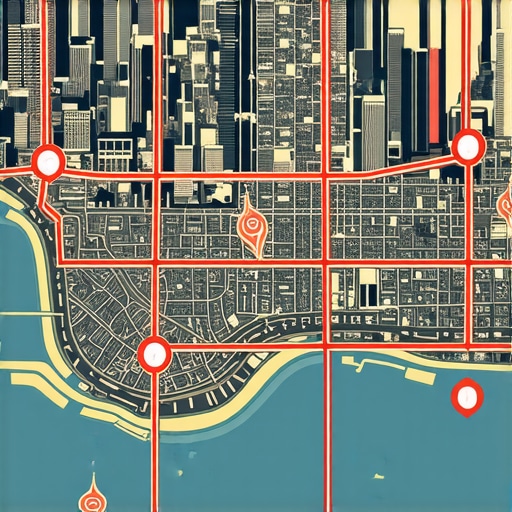
Don’t just embed a static map of your office. That tells Google you are there, not here. Instead, use local seo tools to create a custom Google My Map. This map should show a “service radius” or, better yet, pins of recent projects (without exact addresses for privacy) in that specific town. This creates a powerful geo-signal that links your business entity to that specific latitude and longitude.
3. Real-World NAP Consistency
Even as a Service Area Business (SAB), consistency is key. Ensure your Name, Address, and Phone number are clearly listed, but emphasize the phone number that handles that specific region. If you have a local tracking number for that town, use it. This reinforces local search visibility by providing a direct line of communication for that specific community.
Using google maps seo tools can help you track how these individual pages impact your “geo-grid.” You want to see your green “ranking circles” expanding from your home base into these targeted satellite cities.
Technical Signals: Schema and Authority
Content is the “what,” but Schema is the “how.” To win at service area business seo, you must speak Google’s language. This means moving beyond basic organization schema and into the granular details of LocalBusiness and areaServed properties.
Your City Page should include Service schema that explicitly lists the zip codes covered. By using the areaServed property, you are providing a machine-readable map of your operations. Many developers miss this, leading to 3 schema mistakes that are silently killing your local map views. When you tell the algorithm exactly which neighborhoods you serve, you reduce the “guesswork” the AI has to do, which often results in a higher placement in the Map Pack for those areas.
Furthermore, understand that the “Virtual Office” era is over. Google has cracked down on UPS Store addresses and co-working spaces with no physical presence. Today, the ranking currency is Real Human Behavior. Google tracks how many people in “Town B” are searching for your brand, clicking your city page, or hitting “click-to-call.” These behavioral signals act as a vote of confidence that overrides the distance filter.
The “Three Towns Over” Strategy: Building Local Prominence
Proximity is a filter, but authority is the override. If you are ten miles away, you have to be twice as “prominent” as the guy across the street from the user. How do you build that prominence without a physical building?
- City-Specific Reviews: When you finish a job in a neighboring town, ask the customer to mention the town name in their review. “Shahid’s team did a great job on our roof in [City Name]!” This is a massive google maps ranking tips secret. Google reads these reviews and associates your GMB profile with that location.
- Local Backlinks: A link from a general SEO blog is worth very little for local rankings. A link from the [City Name] Little League website or the local Chamber of Commerce is gold. It anchors your business to that community’s digital ecosystem.
- Hyperlocal SEO Case Studies: Instead of a generic “Gallery” page, create “Project Spotlights” for each town. “Emergency Pipe Repair in [Neighborhood Name], [City Name].” Include photos of your branded truck in front of recognizable local landmarks.
This strategy allows you to how to outrank local competitors who are actually closer to the customer. When Google sees that you have 50 reviews from residents in City B and the local plumber in City B only has 5, the algorithm often decides that your “Prominence” outweighs the “Distance” factor.
“In the modern local algorithm, proximity is a filter, but authority is the override. If you can prove you are the most relevant answer for a user’s intent, Google will stretch the map to include you.”, Shahid Anwar
Future-Proofing for 2026: AI Answer Engines
The way people search is changing. We are moving away from “Plumber [City]” and toward natural language queries like, “Who is the best rated emergency plumber that services the North Hills area and can come out on a Sunday?”
As we look at what the 2026 Google Maps updates mean for your search visibility, the focus is shifting toward hyperlocal seo and AI-driven discovery. Google Gemini doesn’t just look at keywords; it looks at “Entities.” It wants to see that your business is an active entity in the target town. This means your City Pages must answer specific “near me” intent.
If your page answers common local questions – such as permit requirements in that city or local building codes – you become a “source of truth” for that area. This makes your business the preferred choice for AI-generated answers, which are increasingly dominating the top of the search results page.
Conclusion: Your Digital Storefront Strategy
Building a city page is not a “set it and forget it” SEO task. These pages are your digital storefronts for every town you serve. If you treat them with the same care as your main homepage, the results in your local map pack seo will follow. By combining hyperlocal content, advanced schema, and real-world behavioral signals, you can break through the proximity barrier and dominate the map for miles in every direction.
Success in local search requires the right data. If you are ready to see exactly where you stand and how to bridge the gap between your current position and the top of the Map Pack, I recommend using local seo software to conduct a comprehensive audit of your geo-relevance. The map is expanding – make sure your business is on it.
I’ve been experimenting with creating hyperlocal content for my service area pages, and I can confirm it makes a noticeable difference. Including landmarks, neighborhood names, and even regional weather patterns helps signal relevance to Google. I also started embedding custom maps showing recent projects within the specific town, which seems to boost geo-signals. One challenge I encountered was maintaining NAP consistency across all listings, especially as I add more local phone numbers for different towns. Using local tracking numbers and ensuring uniformity was a game-changer. Has anyone had success with integrating
areaServedschema in a way that really affects rankings? I’m curious how much weight Google gives to schema details versus real-world signals like reviews and backlinks in building local prominence.Building on the idea of hyperlocal relevance, I’ve noticed that adding detailed, neighborhood-specific content really helps strengthen the local signals Google values. For example, mentioning well-known local landmarks or community events in your city pages seems to create more trust and authority. Custom maps are indeed powerful, especially when they highlight recent projects or service areas within a town, rather than just embedding a generic office location. From my experience, consistent NAP data across all listings combined with localized reviews—especially those that mention neighborhood names—can significantly boost prominence.
Regarding schema markup, I’ve experimented with
areaServedin conjunction with detailedLocalBusinessschema, and I’ve seen a noticeable uptick in local rankings. Has anyone noticed if Google weighs schema signals heavily compared to real-world behaviors like review volume and click-through rates? I’m curious if focusing on schema yields faster results or if it’s more about building that real community relevance over time. Would love to hear others’ experiences on balancing these signals for maximum impact.This post really hits home because I’ve experienced firsthand how hyperlocal content can transform a business’s visibility in nearby towns. Incorporating neighborhood-specific details, landmarks, and even local weather patterns adds that extra layer of relevance that Google’s AI seems to prioritize more than ever before. I’ve also started building custom maps with local project pins, and the increase in geo-signals has been noticeable.
One challenge I faced was ensuring uniform NAP across all these new city pages, especially with multiple local extensions. Using tracking numbers for each town and optimizing schema with properties like
areaServeddefinitely helped, but I wonder, how are others automating or managing schema updates at scale? And, more generally, do you think schema signals really move the needle faster than real-world interaction signals such as reviews and click-through rates? Would love to hear more real-world results from others experimenting with these strategies.This post really emphasizes how crucial hyperlocal content and schema are when trying to break out of the proximity filter. I’ve been experimenting with creating city-specific pages that highlight local landmarks, events, and weather patterns, and I’ve noticed a tangible boost in local rankings. Embedding custom maps showing recent projects within each town, rather than just a static office location, seems to add that extra geo-signal that Google’s AI loves. One thing I’ve struggled with is maintaining NAP consistency across multiple listings—using local tracking numbers and uniform schema has helped, but automating schema updates at scale remains a challenge for me. Has anyone figured out efficient ways to manage schema for numerous city pages? Also, I wonder how much Google weighs schema data against real-world signals like review volume and click-through performance. In your experience, which tends to move rankings faster? I’d love to hear how others are balancing these signals for maximum local prominence and map visibility.
The article really resonates with my own experience in hyperlocal SEO. Creating dedicated city pages with tailored, neighborhood-specific content has made a tangible difference in our rankings, especially when combined with custom maps that visually demonstrate our service radii. The challenge I often face is ensuring that schema markup, particularly
areaServed, is correctly implemented at scale across multiple pages. I’ve started exploring automation tools that can help manage schema updates more efficiently, which saves a lot of time and reduces errors. From what I’ve seen, schema signals alone don’t move the needle as much as consistent, genuine reviews and strong backlinks from local sources, but they are certainly a valuable part of the overall strategy. I’d be interested to hear from others—how do you prioritize schema versus real-world signals in your local SEO efforts? Also, has anyone found a particularly effective way to track the impact of schema on local rankings over time? Great insights and a reminder to keep hyperlocal efforts authentic and detailed.